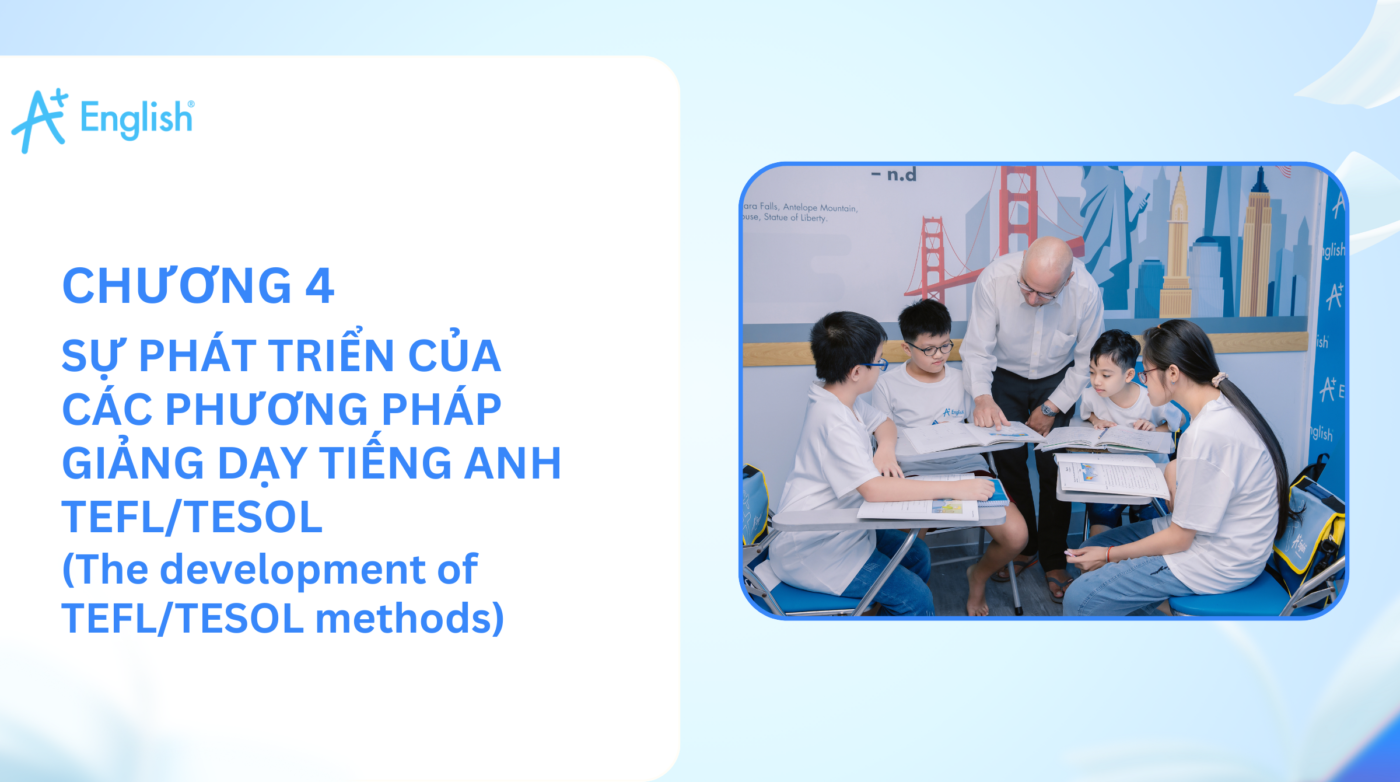
Trong loạt bài viết này, A+ English chia sẻ chuyên sâu về TESOL, từ giảng dạy tiếng Anh, chứng chỉ nghề nghiệp đến kỹ năng lớp học và định hướng phát triển sự nghiệp giáo viên. Chương 3 của The Ultimate TESOL Guide tập trung vào “Sự Phát Triển Của Các Phương Pháp Giảng Dạy Tiếng Anh (TEFL/TESOL)”, giúp người đọc hiểu rõ hơn về các khía cạnh quan trọng trong lĩnh vực TESOL.
Nội dung chính
4.1. Phương pháp Dịch Ngữ Pháp
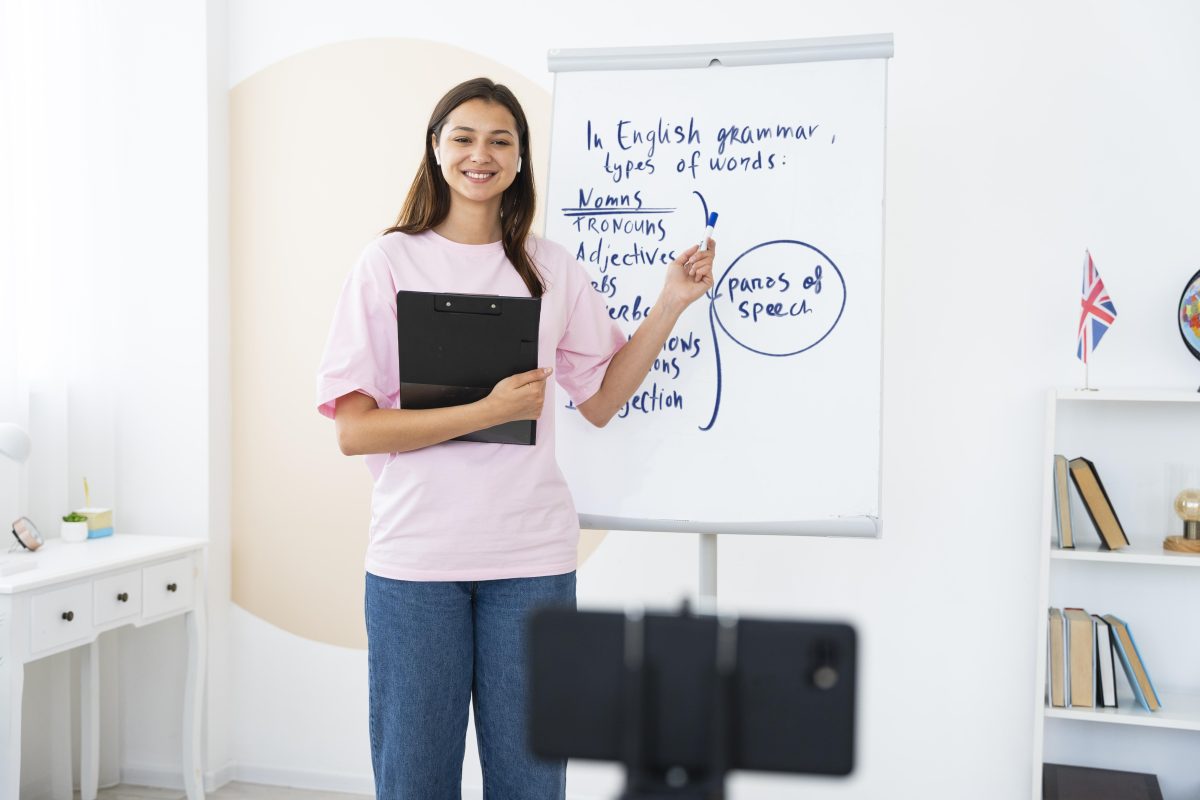
Phương pháp Dịch Ngữ Pháp (Grammar Translation Method – GTM) còn được gọi là phương pháp cổ điển. Khi người phương Tây muốn học các ngôn ngữ “nước ngoài” như tiếng Latin và Hy Lạp, phương pháp này đã được phát triển. Trọng tâm của GTM nằm ở các quy tắc ngữ pháp, việc ghi nhớ từ vựng, các dạng biến cách và chia động từ, dịch văn bản, cùng các bài tập viết.
Theo Brown (2001), một lớp học áp dụng phương pháp Dịch Ngữ Pháp có thể trông như sau:
- Các tiết học chủ yếu được giảng dạy bằng tiếng mẹ đẻ, việc sử dụng ngôn ngữ đích rất hạn chế.
- Việc dạy từ vựng chủ yếu dựa trên các danh sách từ rời rạc.
- Có những phần giải thích dài dòng và chi tiết về các cấu trúc ngữ pháp phức tạp.
- Ngữ pháp cung cấp các quy tắc kết hợp từ, và việc luyện tập thường tập trung vào cấu trúc và hình thái của từ.
- Học sinh bắt đầu đọc các tác phẩm kinh điển khó từ rất sớm.
- Nội dung văn bản ít được chú trọng, vì chúng được coi là bài tập phân tích ngữ pháp.
4.2. Phương pháp Trực tiếp
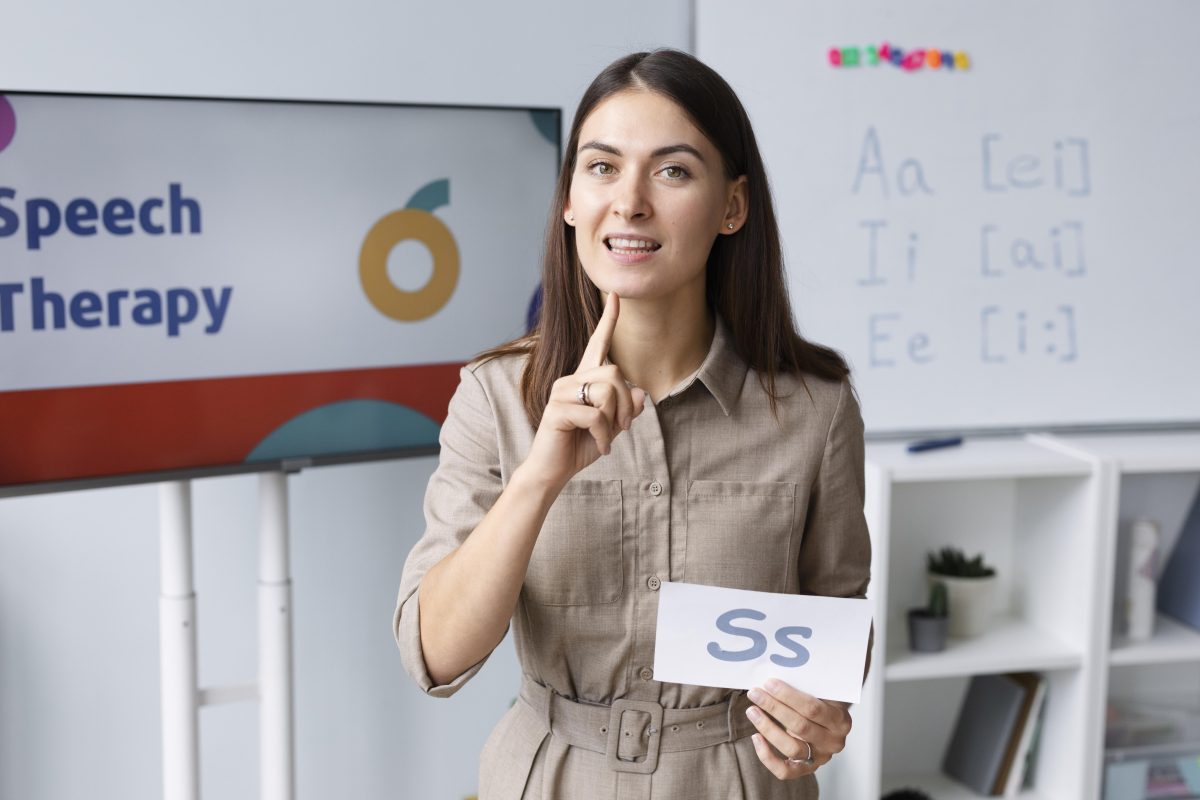
Ý tưởng cốt lõi của Phương pháp Trực tiếp là việc học ngôn ngữ thứ hai nên giống như cách con người học ngôn ngữ mẹ đẻ. Phương pháp này nhấn mạnh vào giao tiếp bằng lời, sử dụng ngôn ngữ một cách tự nhiên, không dịch giữa hai ngôn ngữ và ít hoặc không giảng dạy quy tắc ngữ pháp một cách tường minh.
Theo Brown, các nguyên tắc của phương pháp Trực tiếp bao gồm:
- Lớp học được giảng dạy hoàn toàn bằng ngôn ngữ đích.
- Chỉ ngôn ngữ thông dụng và câu hội thoại thường ngày được dạy.
- Kỹ năng giao tiếp bằng lời được phát triển trong các lớp nhỏ, thông qua tương tác hỏi – đáp có cấu trúc giữa giáo viên và học viên.
- Ngữ pháp được giảng dạy theo hướng quy nạp (rút ra quy tắc qua ví dụ).
- Chủ đề mới được giới thiệu thông qua mô phỏng và thực hành.
- Từ vựng cụ thể được dạy bằng hình ảnh, vật thật, minh họa, trong khi từ vựng trừu tượng được dạy thông qua liên tưởng ý nghĩa.
- Cả kỹ năng nghe hiểu và nói đều được chú trọng.
- Phát âm và ngữ pháp chuẩn xác được coi trọng.
4.3. Phương pháp Nghe – Nói

Trong những năm 1950 và 1960, phương pháp Nghe – Nói (ALM) được sử dụng rộng rãi tại Hoa Kỳ và nhiều quốc gia khác, và đến nay vẫn còn được áp dụng trong một số chương trình. Phương pháp này dựa trên quan điểm cấu trúc về ngôn ngữ, tập trung vào việc nắm vững các đơn vị cấu trúc và nguyên tắc kết hợp chúng.
Phương pháp này chịu ảnh hưởng sâu sắc của thuyết hành vi (Behaviorism), với các nguyên lý sau:
- Học ngôn ngữ là quá trình hình thành thói quen.
- Lỗi sai là không mong muốn vì chúng tạo ra thói quen xấu.
- Kỹ năng ngôn ngữ được học hiệu quả hơn khi bắt đầu bằng lời nói, sau đó mới đến chữ viết.
- Suy luận bằng tương đồng (analogy) hiệu quả hơn là phân tích (analysis) trong việc học ngôn ngữ.
- Nghĩa của từ chỉ có thể hiểu trong ngữ cảnh ngôn ngữ và văn hóa cụ thể.
Các mục tiêu chính của ALM bao gồm: phát âm và ngữ pháp chính xác, phản ứng nhanh và đúng trong giao tiếp, và vốn từ đủ dùng cho các mẫu câu ngữ pháp.
Một khóa học theo phương pháp ALM thường bao gồm các bước:
- Học viên nghe mẫu hội thoại.
- Học viên lặp lại từng dòng của đoạn hội thoại.
- Một số từ khóa hoặc cụm từ được thay đổi trong hội thoại.
- Cấu trúc chính của hội thoại được dùng làm nền tảng cho các bài luyện mẫu câu (pattern drills).
- Trong các bài luyện này, học viên thực hành thay thế và biến đổi mẫu câu.
4.4. Phản ứng toàn thân
TPR là phương pháp dạy ngôn ngữ sử dụng các chuyển động cơ thể để phản ứng với các chỉ dẫn bằng lời nói, giúp giảm căng thẳng, lo lắng và rào cản tâm lý trong học tập. Phương pháp này giúp học viên phản xạ tự nhiên, ghi nhớ lâu hơn, và học ngôn ngữ một cách thoải mái.
Để áp dụng hiệu quả, cần lên kế hoạch bài học logic, thường xuyên và có trình tự rõ ràng.
4.4.1. Các lý thuyết nền tảng của TPR
4.4.1.1. Lý thuyết về cách trẻ em tiếp thu ngôn ngữ
Trước khi biết nói, trẻ em được tiếp xúc với lượng đầu vào ngôn ngữ khổng lồ.
Người học ngoại ngữ có thể bắt chước con đường tự nhiên này – từ hiểu đến nói, thay vì bị ép phải nói ngay từ đầu.
4.4.1.2. Sự phân chia não trái – não phải
- Bán cầu trái: logic, phân tích, lý trí – thường được kích hoạt khi học ngữ pháp, lý thuyết.
- Bán cầu phải: sáng tạo, trực giác, cảm xúc – hoạt động khi vận động, cử chỉ, vẽ, sử dụng hình ảnh và ẩn dụ.
Trong dạy học truyền thống, học viên thường chỉ dùng não trái, khiến kiến thức bị lưu trữ trong trí nhớ ngắn hạn và dễ quên.
Ngược lại, khi ngôn ngữ được học thông qua chuyển động và trải nghiệm thực tế, não phải “tin tưởng” và lưu giữ lâu dài — giống như việc học bơi hay đi xe đạp.
4.4.1.3. Giảm căng thẳng và rào cản cảm xúc
Khi học viên thư giãn và thoải mái, họ học tốt hơn. Ngược lại, khi lo lắng hoặc sợ sai, “bộ lọc cảm xúc” (affective filter) sẽ ngăn cản việc tiếp nhận thông tin.
TPR giúp giảm đáng kể căng thẳng, vì học viên không phải nói ngay, và giáo viên dễ dàng chỉnh lỗi mà không gây áp lực. Nhờ đó, ngôn ngữ được ghi nhớ tự nhiên và lâu dài.
4.4.2. Một số nguyên tắc của TPR
- Chuẩn bị kịch bản trước khi dạy, tránh thay đổi ngôn ngữ giữa chừng.
- Xây dựng trên nền kiến thức cũ, kết hợp với ngôn ngữ mới mỗi buổi học.
- Ôn tập thường xuyên để củng cố.
- Không thay đổi cách diễn đạt trong ngôn ngữ đích để tránh gây rối cho học viên.
- Thái độ thân thiện, tích cực giúp học viên thư giãn.
- Giới thiệu ít cấu trúc mới mỗi lần, nhưng thực hành nhiều lần dưới nhiều hình thức khác nhau.
- Thêm yếu tố hài hước, giúp lớp học vui vẻ, sinh động.
- Không ép học viên nói hoặc dịch, vì điều này phá vỡ lợi ích của TPR.
4.5. Phương pháp Dạy học Giao tiếp

Mục tiêu của phương pháp dạy học giao tiếp là phát triển năng lực giao tiếp.
Khái niệm này được hiểu rõ hơn khi so sánh với năng lực ngữ pháp (grammatical competence) – tức là khả năng hiểu và tạo ra câu đúng ngữ pháp. Năng lực ngữ pháp tập trung vào các thành phần của câu (loại từ, thì, mệnh đề, cấu trúc,…) và cách kết hợp chúng.
Tuy nhiên, chỉ có năng lực ngữ pháp chưa đủ để giao tiếp hiệu quả. Một người có thể nắm vững quy tắc nhưng không sử dụng được ngôn ngữ trong thực tế. Vì vậy, năng lực giao tiếp bao gồm khả năng dùng ngôn ngữ linh hoạt, phù hợp và có mục đích.
Các yếu tố của năng lực giao tiếp gồm:
- Biết sử dụng ngôn ngữ cho nhiều mục đích và chức năng khác nhau.
- Biết điều chỉnh cách nói phù hợp với ngữ cảnh và người nghe (ví dụ: khi nào dùng trang trọng, khi nào thân mật, khi nào dùng văn viết hay văn nói).
- Có khả năng hiểu và tạo ra nhiều thể loại diễn ngôn (tường thuật, phỏng vấn, báo cáo, hội thoại…).
- Biết duy trì giao tiếp ngay cả khi vốn từ hoặc ngữ pháp còn hạn chế, thông qua chiến lược diễn đạt khác nhau.
Hiện nay, việc học ngôn ngữ được nhìn nhận theo hướng mới, cho rằng nó hình thành thông qua:
- Tương tác giữa người học và người sử dụng ngôn ngữ.
- Cùng nhau xây dựng và thương lượng ý nghĩa.
- Sử dụng ngôn ngữ trong các tình huống có mục đích thực tế.
- Chú ý đến phản hồi trong giao tiếp để điều chỉnh cách diễn đạt.
- Quan sát ngôn ngữ đầu vào (input) và cố gắng áp dụng cấu trúc mới vào kỹ năng giao tiếp.
- Thử nghiệm nhiều cách diễn đạt khác nhau để nâng cao hiệu quả giao tiếp.
4.6. So sánh các phương pháp giảng dạy ngôn ngữ
| Đặc điểm | Phương pháp Dịch – Ngữ pháp | Phương pháp Nghe – Nói | Phương pháp Dạy Ngôn ngữ Giao tiếp |
| Quy tắc ngữ pháp | Là đặc điểm trung tâm (Central feature). | Không được giải thích (Not explained). | Được giải thích và cần thiết, nhưng không phải là mục tiêu cuối cùng (Explained and necessary, but not an end in themselves). |
| Giao tiếp có ý nghĩa | Bị xem nhẹ (Deemphasized). | Quan trọng nhưng được xem là chỉ đến từ việc thành thạo các mẫu câu (Important but seen as coming exclusively from mastery of models). | Là trung tâm của phương pháp (Central feature). |
| Trọng tâm chính | Phát âm bị xem nhẹ, chủ yếu là phương pháp để dạy “ngôn ngữ chết” (Deemphasized – primarily a method for teaching “dead languages” after all). | Mục tiêu là phát âm giống người bản ngữ theo các mẫu có sẵn (Target = native-like pronunciation according to models). | Mục tiêu là phát âm dễ hiểu, tự nhiên (Target = comprehensible pronunciation). |
| Dịch thuật | Là đặc điểm trung tâm (Central feature). | Bị phản đối (Discouraged). | Được sử dụng khi cần thiết, là một công cụ trong số nhiều công cụ khác (Used when necessary. It is one tool among many). |
| Trình tự bài học | Dựa trên độ phức tạp ngôn ngữ (Based on linguistic complexity). | Dựa trên độ phức tạp ngôn ngữ (Based on linguistic complexity). | Dựa trên nhu cầu của người học, đồng thời công nhận độ phức tạp của ngôn ngữ (Follows learners’ needs but also recognizes linguistic complexity). |
| Vai trò của giáo viên và học sinh | Lấy giáo viên làm trung tâm (Teacher-centered). | Lấy giáo viên làm trung tâm (Teacher-centered). | Giáo viên đóng vai trò là người hướng dẫn, tạo điều kiện cho sự tương tác giữa học sinh, tập trung vào nhu cầu, cách học và sở thích của học sinh (Teacher facilitates student-to-student interaction and focuses on student needs, ways of learning & interests). |
| Thái độ đối với lỗi sai | Đề cao sự chính xác (Accuracy emphasized). | Đề cao sự chính xác (Accuracy emphasized). | Việc mắc lỗi là một phần tự nhiên của quá trình học và có thể được sử dụng để đánh giá sự phát triển của người học (Making mistakes is part of the learning process and can be used to gauge learner development). |
| Cân bằng kỹ năng ngôn ngữ | Nhấn mạnh kỹ năng đọc và viết (Reading and writing emphasized). | Nhấn mạnh kỹ năng nghe và nói (Listening and speaking emphasized). | Các kỹ năng được dạy dựa theo nhu cầu của người học (Skills taught according to learners’ needs). |
Ghi nhớ:
Không có phương pháp nào là đủ đầy khi đứng một mình. Hãy ghi nhớ rằng học sinh có những phong cách học tập và kỳ vọng khác nhau. Hãy xem xét cảm nhận của người học về chính họ trong vai trò là người học ngôn ngữ. Những cảm xúc tiêu cực về quá trình học tập có thể cản trở việc học. Việc nâng cao sự tự tin của người học sẽ dẫn đến kết quả học tập thành công. Làm việc cùng nhau theo nhóm là một phần thiết yếu trong việc học ngôn ngữ. Các thành viên trong nhóm hỗ trợ lẫn nhau, và sự tương tác giữa họ tạo ra nhu cầu thực sự cho việc giao tiếp và cơ hội để thực hành ngôn ngữ đích.
4.7. Gợi ý cho lớp học
Phương pháp Dịch Ngữ Pháp và Phương pháp Nghe – Nói
Hãy thử điều chỉnh sự kết hợp của Phương pháp Dịch Ngữ Pháp và Phương pháp Nghe – Nói này nếu học sinh của bạn cảm thấy cần phải biết quy tắc cho một đặc điểm ngữ pháp cụ thể nào đó. Hãy thông báo cho học sinh rằng các em sẽ tự mình xác định các quy tắc đó. Sau đó, yêu cầu học sinh thực hiện một loạt các bài tập mẫu theo phương pháp Nghe – Nói để thể hiện đặc điểm ngữ pháp đó. Sau khi hoàn thành các bài luyện, hãy mời một số học sinh xung phong thử phát biểu quy tắc. Nếu các em gặp khó khăn trong việc diễn đạt quy tắc, hãy giúp đỡ bằng cách đặt ra các câu hỏi gợi mở.
Phương pháp Trực Tiếp và Phương pháp Nghe – Nói
Các cuộc hội thoại, đoạn đối thoại và câu chuyện ngắn có thể được sử dụng để kiểm tra khả năng suy luận nghĩa từ ngữ cảnh của học sinh. Hãy sử dụng hình ảnh và tiêu đề để dự đoán chủ đề của buổi thảo luận hoặc bài đọc. Yêu cầu học sinh lắng nghe một hoặc hai từ cụ thể, phát đoạn ghi âm ngắn (không quá hai đến ba phút), và xác định nghĩa của các từ đó. Yêu cầu học sinh xác nhận lại dự đoán của mình bằng cách mô tả các gợi ý mà họ đã sử dụng. Các cuộc hội thoại cũng là phương pháp tuyệt vời để luyện tập các mẫu câu giao tiếp như chào hỏi và tạm biệt, các yêu cầu đơn giản, lời mời, lời xin lỗi, lời khen, v.v. Những tài liệu và hoạt động này đặc biệt hữu ích trong các buổi học kèm một – một.
Phản Ứng Thể Chất Toàn Diện (TPR)
Học sinh có thể được giới thiệu với các từ vựng mới bằng phương pháp này. Phương pháp này đặc biệt hữu ích với trẻ nhỏ, nhưng cũng có thể áp dụng hiệu quả cho người lớn trong các chuỗi hành động. Ví dụ, mỗi khi bạn giải thích các chỉ dẫn, hãy để học sinh thực hiện chúng cả khi có lặp lại và khi không có lặp lại. Điều này sẽ giúp tăng cường khả năng hiểu và ghi nhớ. Các bài tập TPR cũng là một kỹ thuật hiệu quả để “phá băng” trong buổi học khi học sinh đã ngồi trong thời gian dài.
Các Phương Pháp Giao Tiếp
Việc sử dụng ngôn ngữ thực tế là một trong những đặc điểm nổi bật của nhiều phương pháp giảng dạy ngôn ngữ giao tiếp. Hãy tìm kiếm cơ hội sử dụng tiếng Anh trong các hoạt động hằng ngày, chẳng hạn như ghi lại tin nhắn điện thoại giúp bạn bè hoặc đóng vai người phiên dịch cho ai đó nói tiếng Anh nhưng không biết ngôn ngữ địa phương. Hãy chuyển những bài tập này thành hoạt động trên lớp nhằm khuyến khích học sinh và cho phép họ thể hiện khả năng tiếng Anh của mình trong các tình huống thực tế. Khiến người khác hiểu điều bạn nói và hiểu điều người khác nói được gọi là “đàm phán ý nghĩa” (negotiating meaning) — và được xem là khía cạnh quan trọng nhất của giao tiếp hiệu quả.
Theo Phương pháp Giao Tiếp, khía cạnh quan trọng nhất của việc học ngôn ngữ nước ngoài là đạt được khả năng truyền đạt suy nghĩ của mình một cách trôi chảy và sáng tạo, đồng thời hiểu điều người khác nói (tức là sự lưu loát), ngay cả khi không biết tất cả từ vựng. Phương pháp này ít nhấn mạnh hơn vào kỹ năng ngữ pháp hoàn hảo (độ chính xác). Điều bạn nói quan trọng hơn cách bạn diễn đạt. Việc giảng dạy nhấn mạnh kỹ năng nói là kỹ năng chính của học sinh.
Hoạt động giao tiếp nên chiếm phần lớn thời gian trên lớp, sau đó là nghe (trong phần thảo luận), rồi đến đọc và cuối cùng là viết. Tất cả các kỹ năng đều được sử dụng ngay lập tức, và các tiết học nhấn mạnh giao tiếp hiệu quả — bao gồm việc nói điều bạn muốn nói và hiểu điều người khác muốn nói. Trong Phương pháp Giao Tiếp, kỹ năng dịch không được xem là quan trọng. Vì vậy, các hoạt động trên lớp hoặc bài tập về nhà yêu cầu dịch thuật không được sử dụng. Nên khuyến khích chỉ sử dụng tiếng Anh trong suốt buổi học.
Giáo viên đóng vai trò là người hướng dẫn chính trong Phương pháp Giao Tiếp. Điều này có nghĩa là giáo viên hoạt động như một người hỗ trợ, khuyến khích học sinh nói chuyện với nhau và tạo cơ hội cho các em thực hành. Để đảm bảo tất cả học sinh đều có thể tham gia và học tập, giáo viên nên cố gắng đạt được sự cân bằng về tính cách trong lớp học. Học sinh rụt rè cần được khuyến khích để nói, trong khi những học sinh tự tin nên được nhẹ nhàng kiểm soát để không nói quá nhiều và chiếm toàn bộ buổi học. Học sinh là trung tâm của hoạt động khi họ nói, nghe và giao tiếp với nhau. Giáo viên khởi xướng sự tương tác giữa học sinh và đôi khi có thể tham gia; tuy nhiên, trách nhiệm chính của giáo viên là di chuyển quanh lớp, hướng dẫn, giúp học sinh bám sát nhiệm vụ và giao tiếp hiệu quả hơn (bao gồm trả lời câu hỏi của học sinh, đánh giá hiệu suất và chỉnh sửa ngữ pháp). Thông thường, học sinh làm việc theo nhóm nhỏ. Nên có nhiều sự tương tác giữa học sinh với nhau hơn là giữa học sinh và giáo viên. Những buổi giảng dài, nơi học sinh không có sự tương tác với giáo viên, không được khuyến khích. Giáo viên nên cố gắng tạo ra một môi trường lớp học thân thiện và thoải mái. Bởi vì học sinh sẽ thường xuyên nói và bày tỏ quan điểm, ý kiến của bản thân, nên việc tạo ra một môi trường an toàn và dễ chịu là điều vô cùng quan trọng. Không nên chấp nhận những bình luận khiếm nhã từ các học sinh khác.
4.1.The grammar translation method
Grammar Translation is also known as a classical method. When westerners want to acquire “foreign”languages such as Latin and Greek, this approach was developed.The emphasis of GTM was on grammatical rules, vocabulary memorization, numerous declensions and conjugations, translations of texts, and writing tasks
According to Brown (2001), a Grammar translation Method-applied classroom may look like this:
- Classes are taught mostly in the native language, with limited usage of the target language
- The majority of vocabulary instruction consists of lists of isolated words
- Long,detailed explanations of the complexities of grammar are provided
- Grammar offers the rules for combining words, and training frequently concentrates on word structure and inflection
- Reading challenging classical books begins at an early age
- The content of texts is given little consideration since they are considered as exercises in grammatical analysis
4.2.The direct method
The fundamental idea of the Direct Method was that second language acquisition should resemble first language acquisition. The method would involve extensive oral engagement,spontaneous language use, no translation between the first and second languages, and minimal or no understanding of grammatical rules
Here are the direct method’s premises, based on Brown’s arguments:
- Instruction in the classroom was conducted solely in the target language
- It was only common language and sentences that were taught
- Oral communication skills were developed in small intensive classes through a carefully structured development of question-and-answer interactions between teachers and students
- Grammar was instructed inductively
- New teaching topics were introduced by modeling and practice
- Concrete language was taught via demonstration, objects, and images,whereas abstract vocabulary was taught through the association of ideas
- Both spoken communication and listening comprehension were taught
- The importance of proper pronunciation and grammar was highlighted.
4.3.Audio Lingual Methods
In the 1950s and 1960s, the audio-lingual method (ALM) was widely employed in the United States and other nations. Some programs continue to use it now.The structural view of language underpins this methodology. The focus was on mastering the linguistic building blocks and acquiring the principles for mixing them
Behaviorism profoundly influences ALM. The fundamental principles are:
- Language learning is habit development
- Errors are undesirable and should be avoided, as they create undesirable habits
- It is more effective to learn language skills if they are first delivered orally, then in written form
- Analogy is a stronger basis for language acquisition than analysis
- Only in a linguistic and cultural context can the meanings of words be learned
ALM has several important goals, including correct pronunciation and grammar, the capacity to respond quickly and accurately in speech situations, and a sufficient vocabulary for use with grammatical patterns
Typically,the following steps would be taken in an audio-lingual course:
- Students hear a model dialogue
- Students repeat each line of the dialogue
- Certain essential words or phrases may be altered in the dialogue
- The dialogue’s key structures serve as the basis for various pattern drills.
- Within the pattern drills, the pupils practice substitutes.
4.4.Total Physical Response (TPR)
TPR (Total Physical Response) is a method of teaching language that uses physical movement to react to verbal input in order to decrease student inhibitions and the affective filter. It allows students to respond to language without excessive thought, enhances long-term retention, and reduces worry and stress among students. To properly utilize TPR, it is vital to schedule frequent sessions that follow a logical progression, and to keep key concepts in mind.
4.4.1.Theories underlying TPR
4.4.1.1. Theories of childhood language acquisition
Before speaking, children are exposed to a massive amount of language input.Additionally, language learners can benefit from following this “natural” path from comprehension to output, as opposed to the more typical circumstance in which learners are expected to produce immediately.
4.4.1.1. The right brain vs left brain division
The left hemisphere of the brain is rational,unidirectional, and cynical. It is utilized when debating, evaluating, etc. The majority of classroom activities in Japan target the left hemisphere. When moving, acting, utilizing metaphor, sketching,gesturing, etc., the right brain is utilized. In Japanese schools, sports and extracurricular activities aim to achieve this.
When language is taught by lecturing or explanation, the cynical left brain is addressed,and knowledge is stored in short-term memory (if at all). It is quickly forgotten since it is never “genuine”to the student.
When language is actively taught through movement, the right brain “believes” and maintains the information in the same manner that skills such as swimming and riding a bicycle are retained for a lifetime.
4.4.1.2. Reduced stress and emotional filter
When students are relaxed, they learn more. When students are scared or uncomfortable,their affective filter, a mental barrier between them and the material, is raised. When the affective filter is elevated, it is more difficult for students to comprehend, retain, and remember information.
TPR aids in lowering the emotional filter since it is less scary than conventional language activities. Students are not required to generate language. The teacher can readily and painlessly fix any errors that are made. Language is easily and permanently recalled.
4.4.2.Some principles
Prepare a script
It is essential to prepare a script for what you intend to accomplish, as it is crucial not to change the language in the middle of the performance. Additionally, it is essential to recombine previously acquired language in novel ways. It is quite difficult to improvise the commands due to these characteristics and the tempo required for successful TPR training.
Build on what has gone before
TPR instruction should be viewed as a progression, with new language being introduced 1 to and blended with old language at each session.
Recycle language and thoroughly review
Similarly, previously taught language should be regularly reviewed and reintroduced into classes in order to reinforce.
Avoid modifying in target language
While it can be beneficial to introduce synonyms, it is crucial that the language be not altered in the middle of a session. Students are highly confused by this.
Be affable and optimistic
In order for pupils to relax and feel at ease during TPR practice, the instructor must present a warm and upbeat attitude.
Introduce few new items and modify them extensively
To prevent student overload and to allow pupils to assimilate and absorb the language.it is crucial to restrict the quantity of new items introduced. To provide pupils with extensive practice,it is necessary to manipulate new and old language in a number of ways.
Incorporate some levity
Once students are accustomed to TPR practice, a small touch of humor can significantly boost their interest and satisfaction in class.
Students don’t speak
Students should not be required to repeat directions or speak before they are prepared.
Students do not “assist” one another.
The meaning of the TPR orders should be readly apparent from the context,the teacher’s explanation,and previously taught language.
When translating orders into Japanese,the benefits of TPR are lost due to the reversion to left brain input. Additionally, students’ listening skills are not enhanced.
4.5. Communicative language teaching
The objective of communicative language instruction is the instruction of communicative competence. What is this term’s definition? Perhaps this phrase can be clarified by comparing it to the notion of grammatical competence. Grammatical competence refers to the knowledge of a language that enables us to construct sentences in that language. It relates to understanding the components of sentences (such as parts of speech, tenses,phrases,clauses,and sentence patterns) and how sentences are constructed.
Grammatical proficiency is the focus of many grammar practice books,which typically give a grammatical rule on one page and tasks for practicing its application on the opposite page. Typically, the unit of analysis and practice is the sentence. While grammatical competence is an important aspect of language learning, it is evident that it is not the only factor involved, as one might master the rules of sentence creation in a language without being able to use it effectively for meaningful communication. The term communicative competence refers to this later skill.
The following facets of linguistic knowledge comprise communicative proficiency:
- Understanding how to use language for a variety of purposes and functions
- Understanding how to adapt our language usage to the context and the audience (e.g.,knowing when to use formal and informal speech or when to use language appropriately for written as opposed to spoken communication)
- Being able to produce and comprehend many forms of writings (e.g., narratives,reports, interviews, conversations)
- Understanding how to continue communication despite having limited linguistic skills (e.g., through using different kinds of communication strategies).
In recent years, language acquisition has been seen from an entirely new angle. It is believed to occur from factors including:
- Interaction between the language learner and language users
- Cooperative construction of meaning
- Using language to create meaningful and purposeful interactions
- Meaning negotiation as the learner and his or her interlocutor arrive at comprehension.
- Learning via attention to the feedback language users receive when using the language
- Observing the language one hears (the input) and attempting to assimilate new forms into one’s growing communicative skills.
- Trying out and experimenting with alternative expressions.
4.6.Comparison on language teaching methods
| Grammar Translation Method | Audio-Lingual Method | Communicative Language Teaching | |
| Grammar Rules | Central feature |
Not explained |
Explained and necessary.
but not an end in themselves |
| Meaningful
Communication |
Deemphasized | Important but seen as coming exclusive from mastery of models |
Primary Focus |
| Pronunciation | Deemphasized primarily a method for teaching “dead language” after all |
Target = native – like pronunciation according to models |
Target=comprehensible pronunciation |
| Translation | Central feature | Discouraged | Used,when necessary.It is one tool among many. |
| Sequencing of Lessons |
Based linguistic complexity |
Based on linguistic complexity |
Follows learners’needs but also recognized linguistic complexity |
| Teacher-Student Roles |
Teacher-centered |
Teacher-centered |
Teacher facilitates student-to-student interaction and focuses on student needs, ways of learning & interests |
| Attitude to Errors |
Accuracy emphasized |
Accuracy emphasized |
Making mistakes is part of the learning process and can be used to gauge learner development |
| Balance of Language Skills | Reading and writing
emphasized |
Listening and speaking
emphasized |
Skills taught according
to learners needs |
Remember:
- No one method is sufficient on its own. Take into account that students have different learning styles and expectations
- Consider how learners feel about themselves as language learners. Negative feelings about the learning process can block learning. Enhancing a learner’s self-confidence leads to successful learning
- Working together as a group is a vital part of language learning. Group members support each other, and the interaction between them provides a real need for communication and an opportunity to practice the target language
4.7.Classroom suggestions
Grammar Translation Method and Audio-lingual Method
Try this modification of the Grammatical Translation and Audio-Lingual Methods if your pupils feel compelled to know the rule for a particular grammar characteristic.Inform your kids that they will independently determine the rules. Then, have students complete a series of audio-lingual pattern drills that show the characteristic. After the drills,request volunteers to attempt to state the rule. If they have difficulty articulating the rule, heIp them with leading questions
Direct Method and Audio-lingual Method
Conversations,dialogues,and brief narratives can be utilized to test pupils’ ability to infer meaning from context. Utilize images and titles to anticipate the topic of the discussion or article. Ask your pupils to listen for one or two specific words, play a recording of a brief segment (no more than two to three minutes), and identify the meaning of the words. Ask your pupils to validate their guesses by describing the hints they utilized. Conversations and conversations are aIso a great method to practice conversational formulae like as greetings and farewells, simple requests, invitations, apologies, praise, etc. These resources are especially beneficial in one-on-one tutoring scenarios
Total Physical Response
Students can be introduced to new terminology using this way. It is particularly helpful with young learners, but also useful for adult action sequences. For instance, whenever you explain directions,have your pupils perform them both with and without repetition.This will increase understanding and retention. TPR exercises are also an effective technique to break up a session in which students have been seated for an extended period of time
Communicative Approaches
Practical language usage is one of the defining characteristics of the many methods of communicative language instruction. Be on the lookout for opportunities to use English in your regular activities, such as taking a phone message for a friend or acting as an interpreter for someone who speaks English but does not know the local language.Adapt these exercises into classroom activities that will encourage your pupils and allow them to exhibit their English proficiency in real-world situations. Getting others to comprehend what you mean when you talk and understanding what they mean when they speak is referTed to as “negotiating meaning” and is regarded as the most important aspect of effective communication.
According to the Communicative Method, the most essential aspect of learning a foreign language is acquiring the ability to fluently and creatively convey your thoughts and comprehend what others are saying (fluency), even without knowing every word. Less emphasis is placed on impeccable grammatical skills (accuracy). What you say takes precedence over how you express it. Teaching emphasizes speaking as the primary student skill
The activity should occupy the majority of class time, followed by listening (as part of discussion), then reading,and lastly writing. All abilities are utilized immediately, and classes emphasize effective communication, including stating what you mean and understanding what others mean. Under the Communicative Method, translation is not an important ability. Therefore class time or homework assignments requiring translation are not employed. It is recommended that only English be spoken during the class.
Facilitator is the primary role of a teacher utilizing the Communicative Method. This implies that the instructor works as a facilitator, encouraging pupils to speak with one another and providing opportunities for them to do so. To ensure that all students are able to engage and learn, the teacher should strive to achieve personality balance in the classroom. Students who are timid must be encouraged to talk, while those who are confident must be gently prevented from speaking excessively and dominating the entire session. Students are in the heart of the action as they speak, listen, and converse with one another. The teacher initiates the interaction between students and may occasionally participate; however, the teacher’s primary responsibility is to circulate around the classroom offering guidance and assisting students in staying on task and communicating more effectively (including answering their questions,evaluating their performance, and correcting grammar). Typically,students work in small groups. There should be far more interaction between students than between teachers.Long lectures in which the students do not interact with the instructor are not encouraged.The instructor should attempt to establish a friendly and easygoing classroom environment.Because students will be speaking frequently and addressing their own views and ideas, it is crucial to create a secure and comfortable environment. Other pupils’ rude comments should not be accepted.

Hy vọng chương này đã giúp bạn hiểu rõ hơn về “Sự Phát Triển Của Các Phương Pháp Giảng Dạy Tiếng Anh (TEFL/TESOL)” trong TESOL. Ở những chương tiếp theo, A+ English sẽ tiếp tục cung cấp các nội dung chuyên sâu, hỗ trợ bạn phát triển kỹ năng giảng dạy và định hướng nghề nghiệp giáo viên tiếng Anh một cách hiệu quả!
XEM THÊM: The Ultimate TESOL Guide: Các Yếu Tố Của Quá Trình Học Tập